

THE BLOCK
Orange Brick Road Crypto Newsletter | 16 November 2026
Bitcoin Crashes to $62K: Why It Fell, Who’s Selling and What Comes Next
Your guide to the crypto markets and what’s ahead. Figures are from reports on 14–15 November and move constantly.
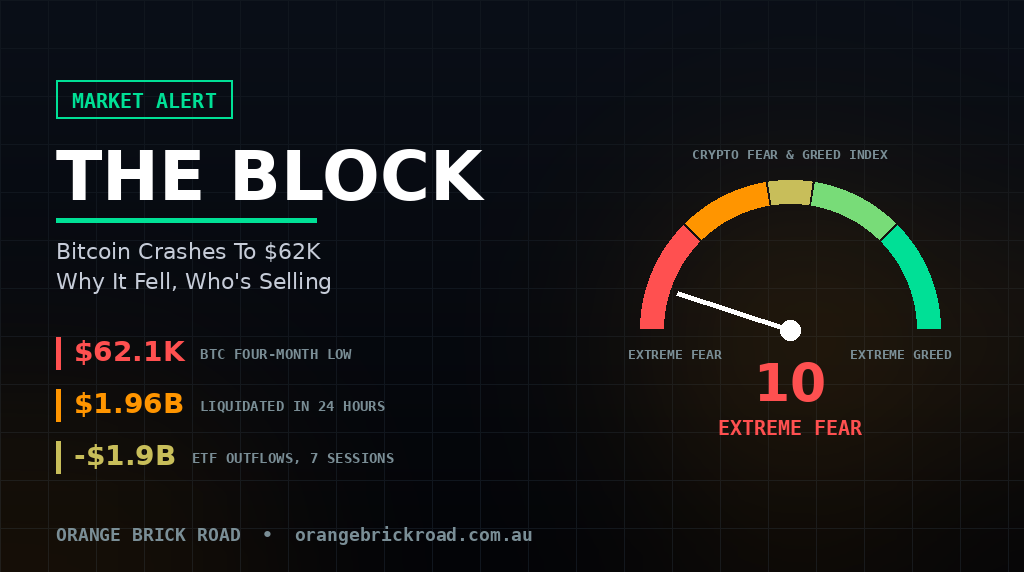
Market snapshot Bitcoin: about $65,000, after a low of $62,081 on Sunday 15 November, a four-month low. Down about 12% on the week and about 23% from its $81,000 peak on 4 November. About 48% below its October 2025 high of roughly $126,000. Fear & Greed Index: 10 (Extreme Fear), its lowest in months. Bitcoin has lost the $70,000 level and its 200-day moving average (about $73,000). Why it crashed
Inflation and rate-hike fears October CPI came in hotter than expected (+0.4% month on month, core +0.3%). The Fed already hiked in September, and futures now price about an 89% chance of another hike on 9 December. The 10-year Treasury yield sits around 5.15%. Higher rates tend to pull money out of risk assets like crypto.
ETF outflows US spot Bitcoin ETFs lost about $1.9 billion over seven sessions (5–13 November), including about $1.07B in the week of 9–13 November. On Friday alone, $185M left, mostly from BlackRock’s IBIT and Fidelity’s FBTC.
Leveraged longs got wiped out About $1.96 billion in crypto positions were liquidated in 24 hours on Sunday, around $750M of it in Bitcoin, mostly longs. Forced selling feeds on itself.
Miner and corporate pressure
MARA disclosed selling 13,597 BTC (about $1.1B), though not necessarily during this drop. Mining difficulty fell 9.1%, suggesting miners are switching off machines and may need to sell. MSCI will remove Strategy from its indexes after 30 November. That pressures Strategy’s shares but doesn’t force it to sell Bitcoin.
Less cash in the system The supply of major stablecoins (USDT, USDC, DAI) shrank by about $11.5B over 30 days.
Binance hack aftermath Trust took a hit after October’s $6.3B hack. Binance’s CEO calls the selling “normal” and says the long-term case is intact.
One outlet argues the stock market is the weakest factor, since the volatility index fell this week.
Who’s selling?
Nobody can name individuals, but the data points the same way:
Mostly the US. Anchorage Digital’s David Lawant says sell pressure comes “primarily from the U.S.”, based on heavy sell flow on Coinbase. The Coinbase Premium (US price vs. offshore) has been negative for 51 days in a row. Exchange flows: Between 11 and 14 November, aggressive selling beat buying by 7,438 BTC on one US-dollar exchange, vs. 2,707 BTC on Binance (Binance Research). ETF holders, led by IBIT and FBTC. Leveraged traders, forced out by liquidations. Not Binance, says its founder. CZ said Binance didn’t sell. Strategy hasn’t reported selling any Bitcoin.
Other theories (selling to fund the planned Anthropic IPO, Binance customers cashing out restored balances) are unproven. There’s no solid data yet on whale or long-term holder selling.
Is this the bottom?
Nobody knows, and no source I found declared one.
Signs it could be close:
Extreme Fear readings are sometimes followed by rebounds. In the past year, though, only about 62% were followed by a higher price 30 days later, with a median gain of just 2%. Bespoke Investment Group calls Bitcoin “deep into oversold territory.” A big liquidation flush clears out leverage.
Reasons for caution:
The 9 December Fed meeting hasn’t happened. ETF outflows are still running. Bitcoin is below its 200-day average, and some analysts are watching $60,000 as the next level.
What would signal a turn (per one outlet): a close back above the 200-day average, and a day of net ETF inflows.
What a sensible investor does now Never use money you can’t afford to lose. Avoid leverage. It’s exactly what drove this week’s liquidations. Decide your plan before the next big move, not during it. Many investors spread purchases over time instead of buying at one price. Don’t act on fear or hype. Extreme Fear readings can persist. Keep long-term holdings off exchanges. Beware of scams. Crashes bring fake “recovery” and “support” messages. What to watch 9 December: the Fed decision, with a hike widely expected ETF flows: whether outflows stop 30 November: Strategy’s removal from MSCI indexes Mining difficulty and miner selling Bitcoin’s 200-day average (about $73,000) and the $60,000 level
Want to talk it through? Book a free 15-minute chat with the Orange Brick Road team: https://calendly.com/brandon-orangebrickroad/15min-call
General information only. Not financial, investment or tax advice, and it doesn’t consider your objectives, financial situation or needs. Orange Brick Road does not hold an Australian Financial Services Licence (AFSL). Crypto is highly volatile and you can lose all your money. Do your own research and speak to a licensed adviser before making decisions.
Sources:
Cointelegraph: US sellers drive Bitcoin crash crypto.news: Bitcoin plunged from $81K to $62K crypto.news: Binance CEO on the selloff 24/7 Wall St.: Why is Bitcoin crashing this week?
More news
General information only. Orange Brick Road Pty Ltd (ABN 92 655 540 480) does not hold an Australian Financial Services Licence and nothing here is financial product advice.