

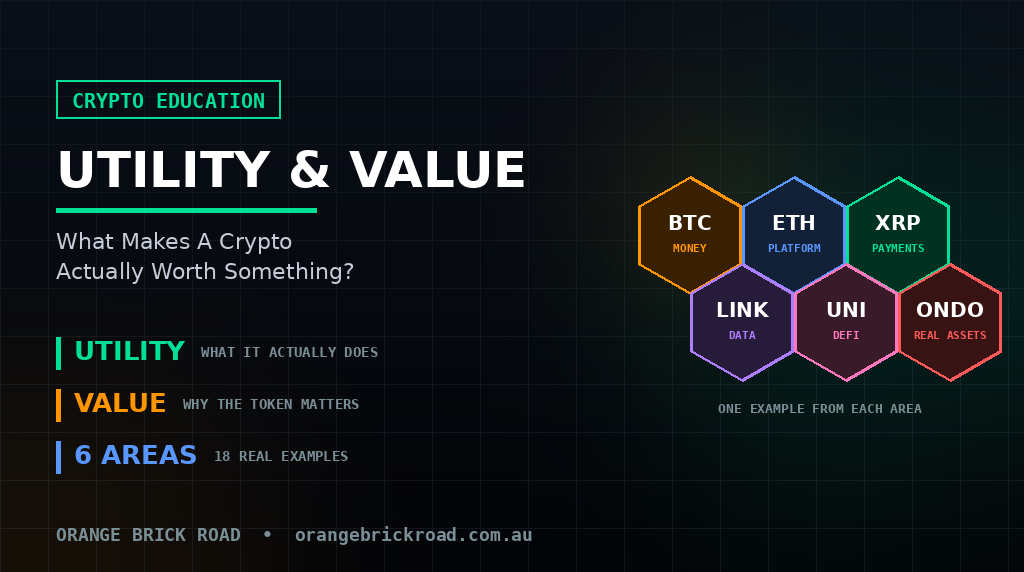
There are thousands of cryptocurrencies, and most will disappear. The ones that last tend to share two things: utility and value. They sound similar, but they aren’t the same, and mixing them up is one of the most common mistakes new investors make.
Utility vs value
Utility is what the project actually does and whether anyone really uses it. Does it solve a real problem? Do real businesses, institutions or everyday people rely on it?
Value is why the token itself is worth something. This is the part people miss. A project can be genuinely useful while its token captures almost none of that success.
A good example is Uniswap, the largest decentralised exchange. For years it was hugely popular, but its UNI token was mostly a voting token. In December 2025, holders approved the “UNIfication” proposal, which switched on protocol fees and burned 100 million UNI from the treasury. The same product now has a much clearer link between usage and the token.
Ondo Finance is the opposite lesson. Its tokenised US Treasury products are widely used, but as of May 2026 the ONDO token itself is mainly a governance token. Holders don’t receive a share of revenue, and a vote on that is expected later in 2026. Useful product, with the token’s role still being decided.
Six questions to ask about any crypto What problem does it solve, and who pays for it? Is it actually used by real people or businesses, not just traders? Does the token need to exist? Would the product work without it? How does the token capture value? Fees, burns, staking, scarcity, or only a promise? Is the supply fair and transparent? Who holds the coins, and when can they sell? Does it have a track record, a real team, and regulatory clarity?
Now let’s look at examples across six areas of crypto.
- Digital money and store of value
Bitcoin (BTC): The original. A fixed supply of 21 million, no central owner and the longest track record. Its value comes from scarcity and trust, which is why many treat it as “digital gold”.
Litecoin (LTC): Launched in 2011 as the “silver to Bitcoin’s gold”. It has faster blocks and lower fees, so it’s better suited to everyday payments. It’s one of the longest-running coins still operating.
Monero (XMR): Built for privacy. It hides the sender, receiver and amount by default. The trade-off is regulatory pressure in many countries, so check whether your platform supports it.
- Smart contract platforms
Ethereum (ETH): The largest smart contract platform and home to most DeFi, stablecoins and tokenised assets. ETH pays network fees and is staked to secure the network, and part of each fee is burned.
Solana (SOL): Built for speed and low fees, which suits trading, payments and consumer apps. A newer network with a strong developer community.
Avalanche (AVAX): Lets developers launch their own custom blockchains, which appeals to businesses and institutions that want control over their own network.
- Payments and stablecoins
XRP: Designed for fast, cheap cross-border settlement. Ripple’s RLUSD stablecoin is gaining institutional traction, but adoption headlines don’t automatically mean demand for the XRP token.
Stellar (XLM): Another payments-focused network, used by financial institutions for cross-border payments and tokenised assets.
USD Coin (USDC): A US dollar stablecoin issued by Circle. Its value isn’t about price growth. It’s about being stable, which is why it’s widely used for trading, payments and DeFi.
- Infrastructure and data
Chainlink (LINK): Blockchains can’t see the outside world on their own. Chainlink supplies prices and data, and its cross-chain protocol (CCIP) moves assets between networks. Banks and market infrastructure providers have been testing it.
Filecoin (FIL): A decentralised storage network. FIL is used to pay providers for storing data, so the token has a direct job.
The Graph (GRT): Often called the “Google of blockchains”. It organises blockchain data so apps can search it quickly, and GRT is used to pay the people who index that data.
- Decentralised finance (DeFi)
Aave (AAVE): One of the biggest lending protocols. You can lend or borrow crypto without a bank. The AAVE token is used for governance and for a safety mechanism that backs the protocol.
Uniswap (UNI): The leading decentralised exchange, and the best example of a token that recently gained a clear link to usage through fees and burns.
Lido (LDO): The largest liquid staking provider. It lets you stake ETH and receive a tradable token in return. LDO is the governance token for the protocol.
- Real world assets (RWAs)
Ondo (ONDO): Tokenises US Treasuries and similar assets. A great example of why you need to separate the product from the token.
Blocksquare (BST): Infrastructure that lets property businesses issue and trade tokenised real estate. Importantly, BST is not ownership of property. It’s used within Blocksquare’s own platform, so its value depends on how widely that software is adopted.
Centrifuge (CFG): Brings real-world finance such as loans and invoices on-chain, so they can be financed through DeFi.
The takeaway
Strong projects share a pattern: a real use, real users, a token with a clear job, and a team still building after the hype fades. But each example above also carries real risk. A coin can be the right idea and still fall 70%. Utility is necessary for value, but it doesn’t guarantee a price.
Remember:
Do your own research before you touch anything. Diversify, and never hold more than you can afford to lose. Use the six questions, not social media hype. These examples are for education. They’re not recommendations.
Disclosure: Orange Brick Road has a commercial relationship with Blocksquare. You can see how we’re paid on our services page.
Want help working through it?
Book a free 15-minute chat with the Orange Brick Road team: https://calendly.com/brandon-orangebrickroad/15min-call
General information only. Not financial, investment or tax advice, and it doesn’t consider your objectives, financial situation or needs. Orange Brick Road does not hold an Australian Financial Services Licence (AFSL). Crypto is highly volatile and you can lose all your money. Do your own research and speak to a licensed adviser before making decisions.
Sources:
Cointelegraph: Uniswap burns 100M UNI after fee switch approval Live Bitcoin News: Ondo token value hinges on fee switch vote
More news
General information only. Orange Brick Road Pty Ltd (ABN 92 655 540 480) does not hold an Australian Financial Services Licence and nothing here is financial product advice.